Cathy Johnson’s Mini-class // Quick Sketching 1 - Lesson 4 and wrap up

Tuesday, 16 July 2013

It took me even more time to go through lesson 4, than to go through all of the three previous lessons. I lost focus and got distracted by so many other things lately that this mini-class got to the bottom of my to-do wish list. But here I am, finally.
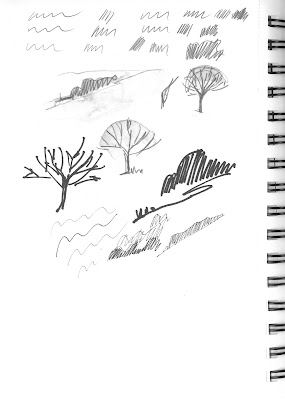
The last lesson focused on tonal values, big shapes and shadows to just give a quick impression of your subject, capturing the atmosphere without going into too much detail. And this is something I have been lacking.
Recognising tonal values has always been difficult for me. It is easier if I’m looking at a black and white picture, but when working on the spot, recognising the value of the colours has proven a real challenge. I can narrow my eyes trying to see the simple value pattern, but it doesn’t always work, especially if I’m looking at a landscape and there are a lot of colours. Doing a quick tonal sketch and adding a value scale can help, but really doesn’t solve my problem; I guess practice will improve my observational skills. In the meantime, I had the chance to test different ways to create tones using different tools and techniques.

My favourite so far is using a water-soluble pen or pencil and a water brush to dissolve the colour and create a shaded wash. Even the most boring drawing can become interesting when adding tones.
Capturing the direction of the light by adding shadows it has also proven to change the mood of a drawing. And one of the best tips I must remember is to always leave some white paper for the lightest lights.
So this is the end of the first of the Cathy Johnson’s online mini-classes! The overall course was good value for money, probably a bit too basic for me, but I am one of those people that forget things easily, so it was a good way to return to the basics and take on board all the tips given in the lessons.

I put together a summary list of all the tips that I should remember when doing a quick sketch, but also of some of the things that I discovered about my tools.

Favourite tools for quick sketching //
  • Faber-castell PITT artist pen sanguine – brush size (waterproof) + watercolours
  • Staedler fine liner 0.3 black (waterproof)
  • Derwent inktense peacock blue (watersoluble)
  • TOMBOW ABT Redwood 899 (watersoluble) brush and fine point + watercolours (THE BEST)
  • Eraser Faber-Castell
Best tips for quick sketching //
  • Consider the time available when starting a sketch - start with the big shapes and add details later on as you have time
  • Consider gesture sketching when trying to capture movement
  • See objects as basic shapes
  • Use thumbnail sketches
  • Develop your own visual symbols
  • Identify tonal values by squinting your eyes
  • Choose/identify light direction
  • Leave some white paper for lighter lights

 I am planning to start the next mini-class, Quick Sketching 2, soon, so watch out for this space!
In the meantime you can have a look at all my sketches from the previous lessons here.

More info about Cathy Johnson’s online classes can be found here.

Cathy Johnson’s Mini-class // Quick Sketching 1 - Lesson 3

Friday, 10 May 2013


It took a bit more time to go through lesson 3, compared to the previous lessons.
The first part focused on sketching from memory, which can be a good exercise as it makes you look harder at your subject and with practice you can learn what to look for, what is essential when trying to do a quick sketch. I must confess I didn’t practice enough on this subject as I was more interested on what was following, meaning thumbnail sketches, visual symbols and big shapes. I think these last three points are the key to quick sketching, and also the points where I lack confidence. I’ve always used thumbnail sketches as a preparatory exercise before tackling a painting. But never realised they can actually be quick sketches on their own. I also learned that it’s a very good exercise copying visual symbols from somebody else’s work. I’ve been recently obsessed with John Lidzey sketches, and looking at the way he drew things, and copying it, made it easier for me to reach a similar effect in my sketches.
Working from a big shapes and adding more details later as time allows has also proven to be a very good tip. When I’m out sketching I don’t always know how much time I’m going to have. Most of the time a big shape is good enough to suggest a view or a movement.
The winter robins demo was an enjoyable exercise, and adding colours to it was for me the most rewarding part!
Sketches from Lesson 1 and 2 can be found here.
More info about Cathy Johnson’s online classes can be found here.

A few holiday's sketches

Thursday, 9 May 2013

Rimessa barche - fine lungomare lato Corace

Quadrivio Nalini

Golfo di Squillace

Tetti - Catanzaro Lido zona Corace

We spent the past week in Catanzaro Lido (Southern Italy), my hometown. The weather was great, sunny and warm, but not too much you get sunburned and your watercolours dry while still on the brush!
Because we went visiting my family, we had baby sitters for my little Miss O basically all day long and that gave me the chance to go out by myself and do some en-plain-air sketching. I had planned to bring with me an A4 Moleskine watercolour pad I bought a few years ago with the plan to fill it in with sketches of my hometown. However, the pressure I felt when thinking about the size and the commitment required made me decided to bring my usual large moleskine pad. It was a good choice, but now I feel I've gained enough confidence to bring my larger pad next time. I was hoping to be able to draw a bit more, but feel quite happy with the overall results. All drawings and watercolours were done on location, with only a few touches added later on.  

Cathy Johnson’s Mini-class // Quick Sketching 1 - Lesson 2

Monday, 22 April 2013


Can't really see much here!


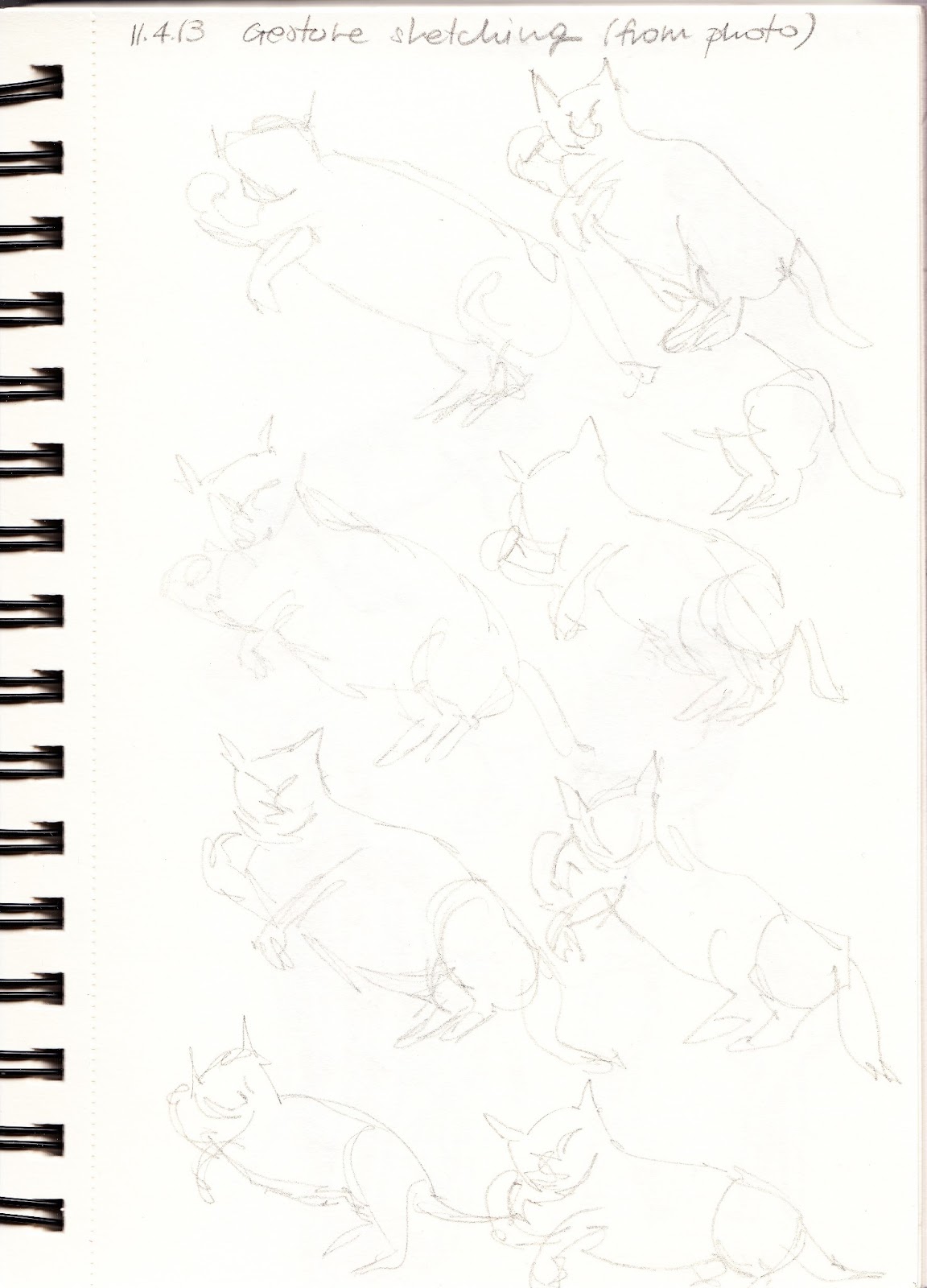
Lesson 2 has been all about sketching a moving object and capturing the essence of it (it’s called gesture sketching, something I didn’t know). I was a bit afraid to start with the exercises. People and animals are not really my favourite subjects, let alone if they are moving. But after watching some of the demo videos included in the class, I geared myself up to the challenge and with some courage I gave it a go.

Drawing using a kitchen timer was one of the many tips given in the lesson. I have done this type of exercise before, but I had forgotten how useful it is to know how much time you have before you start drawing. It helps to decide if focusing on the big picture or looking at details. And this is a problem I always have. I tend to focus on the details when I sketch, and that sometimes overwhelms me, especially when I suddenly realise that I don’t have enough time to draw everything (which happens very often if you try to sketch when out and about with a 16 month old!).

Seeing an object as a number of basic shapes (circles, triangles, etc.) also helped quite a lot, especially when drawing animals. I had learned this technique at one of my botanical art classes, but never really put it into use.    
  
The results are far from great, but I’m hoping that with practice, and a lot of it, my drawing skills will improve.

My sketches from Lesson 1 can be found here.
More info about Cathy Johnson’s online classes can be found here.

Unfinished sketches

Friday, 12 April 2013

My desk @ work

 Kingston library - detail

 A3 to Woking

I have been trying to sketch whenever possible lately, but that means that I don't always have enough time to finish what I started. But that's ok; a little, unfinished drawing is better than no drawing at all in my opinion.

Cathy Johnson’s Mini-class // Quick Sketching 1 - Lesson 1

Tuesday, 9 April 2013


I have been meaning to try out one of Cathy Johnson’s art workshops since I discovered her work a few years ago, but never really found the right time for it. Then a few months back I found myself going through her online art classes and getting more and more excited at the thought of signing up for one. I talked about it for a good couple of months and finally on March 31st I signed up.
The format of these mini-classes is quite simple. Each class costs $30 (which is less than £20) and consists of 4 weekly lessons. Once you’ve signed up, an email containing a link to the lesson (in pdf format) is sent to your address every 7 days. It is up to you to do the rest; the reading, the exercises, the more practicing.
I have been a bit geeky about this mini course and, although I have been sketching for years now, I decided to sign up for the first of the online mini-classes: Quick Sketching 1.
The first lesson included some very basic info and tips, and my first thought was that maybe I should have enrolled for a more advanced class. Much to my surprise I found the lesson very useful to help me get into the idea of what really a quick sketch should be about and also to re-discover some of my old tools.
Here is my sketchbook after week one.

More info about Cathy Johnson’s online classes can be found here.

Trying something new

Thursday, 4 April 2013

I had the chance to come across some new materials I haven’t used before. To be honest, I’m not the type of person that likes to experiment with either materials or techniques. I know it sounds really bad, but not having much time to draw and paint I prefer stick to what I know it gives me some kind of comfort. However, once in a while, I get some free samples of some new products; this is when I don’t really have an excuse for not to trying them out.
A while back, Cass Art opened a new branch in Kingston upon Thames and to celebrate its launch they gave away a very generous goody bag with all sorts of materials.
Amongst some more familiar stuff, like paints and pencils, there were some sketching crayons (Conté Carrés Esquisse) and some watersoluble wax bars (Derwent Artbars), which caught my attention.
I decided to give them a try and these are the results.
I also received a sample of the Derwent XL graphite block and the Derwent XL charcoal block this week. Finding myself in this experimenting mood, I thought I should try these as well. I did not realise at first that one block was graphite and the other one was charcoal so I used them in the same way, in the same drawing…the graphite block did feel harder and less messy than the charcoal one, but not being very familiar with any of the two, I thought it was normal!
I’m no expert in using these media, so I can’t really give a proper review as I’ve got nothing to compare them against. However, I did enjoy trying them out and if I have to pick a favourite that would be the sketching crayons from Conté. They were relatively easy to use, messy, but not too much. I could get some pretty sharp lines and, at the same time, fill in a big area quite quickly. Also, I love sanguine colours!
Second favourite were the Derwent artbars. I loved their smooth lines, the results of overlapping colours and the fact that they are watersoluble. Bit of advice, as they are wax bars, they tend to actually melt in your hands while holding them; the solution is to be quick and make a lot of breaks to avoid heating them too much.
Least favourites are the blocks. The ones I used were samples, so not the actual size and a bit difficult to hold. They were very messy, and not really appropriate for small size drawings, as the XL in the name suggests! Very good for filling in big areas and do some bold and quick sketches, probably excellent for doing some big scale live drawings.

While baby sleeps

Wednesday, 3 April 2013


I love it when my baby girl falls asleep in the car and I can't do anything else but to sketch the surroundings. We went to a softplay place last Monday, called Piglets in Hersham. She had a play date, but the car journey made her fall asleep. So while waiting for her to wake up, I managed to do a quick sketch of the entrance. The watercolours were added later on at home, as she didn't give me much time to do it there.

From my living room window

Sunday, 31 March 2013

 
It is still cold and grey here, and outdoor sketching has been out of question. But my hands were starting to itch, so I sat next to my living room window and started to sketch. The gated area is the Athelstan School car park, which was completely empty being the saturday before Easter. I used a Stabilo point 88 to draw the poles, as I didn't have a flat surface to rest my arm and it would have been difficult to paint straight and fine lines.
I found the winter poplars a bit difficult to draw/paint. I did some online search before painting them, but didn't find much. I just added some additional branches with my pencil after painting them, to make them look a bit better. 

Up in the snowy mountains

Tuesday, 26 March 2013

Aschi Alto - Abruzzo, Italy
We went visiting my in-laws back in February this year. They live in central Italy, up on the mountains and it snows a lot during winter. This sketch was done on location, during one of our afternoon car trips. We pulled the car over the side of the road (we only saw one car driving on the same road that afternoon!). It was cold outside, so I stayed in the car. Shame about the electricity lines, which I love in general; they came out too big, but I didn't really have a flat surface to keep my sketchbook steady.
Related Posts Plugin for WordPress, Blogger...